On Catastrophe: A Tisha Ba'av Reflection
For these crimes and venalities were not committed far away
Oh God — in our name they do these disgraceful things
For these are very close to us
And our mouths are silent and our hearts are asleep and still we are not outraged
From “Woe to the Heart That Is Not Broken” by Aryeh Cohen
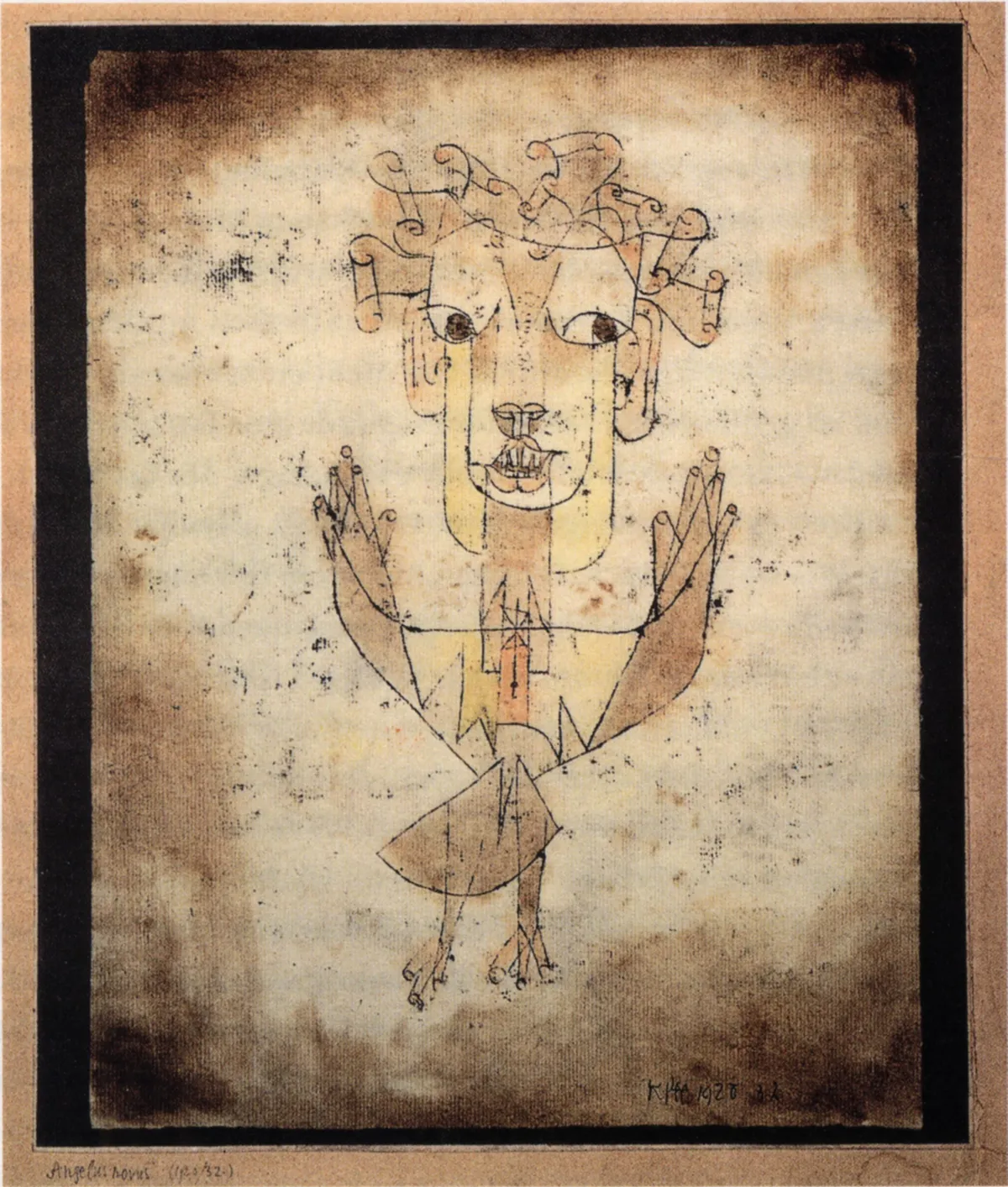
In his essay “Über den Begriff der Geschichte” (often translated as “Theses on the Philosophy of History”), Walter Benjamin is unsparing in his assertion that history is not a linear march toward a more equitable society, which for him is an illusion generated and propagated by history’s victors, but rather “one single catastrophe which keeps piling wreckage upon wreckage.” He draws on Paul Klee’s Angelus Novus, which presents a raw, unvarnished angel stripped of celestial splendor, looking directly at the viewer with its mouth agape, exposing a set of teeth reminiscent of a vulnerable adolescent rather than a divine messenger. For Benjamin, this is the “angel of history,” who desperately longs to “stay, awaken the dead, and make whole what has been smashed,” only to be swept backward by the relentless storm of “progress.”
Last week was the Jewish holiday of Tisha B’Av, a day dedicated to commemorating the destruction of the First Temple; a day dedicated to reckoning with the violence of history; a day dedicated to encountering catastrophe in its totality. On this solemn occasion, tradition calls for reading Eikhah (the Book of Lamentations), a raw account from survivors of the Babylonian destruction of Jerusalem and the Temple. It captures the spirit of individuals desperately attempting to make sense of the recent carnage they endured: simultaneously railing against God’s harsh judgment yet pleading for forgiveness for the sins blamed for their desolation. Few works of literature so brutally lay bare such raw inner torment, shock, and grief.
However, in progressive Jewish spaces, Tisha B’Av is not simply a day to lament an event that occurred thousands of years ago; it is a day for immersing oneself in the catastrophes of modernity, in all that is rotting the world we inhabit. Thus, I can’t help but feel that Benjamin’s angel of history lives in this day—haunts it, even—for, like the angel, we are forced to face an unbearable truth: that we live in an age of ruin very much of our own making. But how is it that we can recognize our own complicity, yet remain so powerless to change course? Yes, we too are caught in an unrelenting storm, swept blindly into the future with nowhere to seek refuge.
—
I spent Tisha B’Av in Israel/Palestine visiting three sites of catastrophe, each distinct in its horror yet bound together by sin’at chinam, the baseless, unconditional hatred that Rabbinic tradition blames for the destruction of the Temple.
My day began in the Gaza Envelope, where we met Avi Dabush, Executive Director of Rabbis for Human Rights and parliamentary candidate. He recounted enduring the horrors of October 7th in his community of Kibbutz Nirim. On that fateful day, he was forced to sit in a safe room with his family for hours on end, listening to the massacre raging just outside, terrified that their safe room, like so many in his kibbutz and the surrounding communities, would be infiltrated by the attackers. Yet, despite being touched by such unimaginable trauma, his outlook remained steadfast. He expressed deep faith that peace can still be achieved, even if it requires twenty to thirty years of relentless work; his credo was ani ma’amin, “I believe.” While I must admit that I question whether this land can endure twenty more years of this blood-soaked status quo, I was astonished by his resilience.
Next, we visited the Bedouin village of Al-Araqib in the Negev Desert, where we met with Sheikh Sayyah Abu Mdeighim, one of the leaders of the community. He shared with us the history of his people, who have lived on this land since the early twentieth century and continue to hold Ottoman-era land deeds that they say prove their ownership. But despite having material evidence that this is their ancestral home, they have since been uprooted and expelled from their original village site. Since 2010, Al-Araqib has been demolished and rebuilt over 250 times.
Surrounded by the physical wreckage of the village, with trash and scattered masonry making a once-flourishing home resemble a junkyard, I listened as Sheikh Sayyah proclaimed, with fiery defiance, that his community would never surrender their land. In that moment, the sheer absurdity of ethno-nationalism laid itself bare. The state demolishes a village in the name of clearing space for a Jewish settlement, yet no settlers arrive, leaving only empty, defiled ground. The absurdity is such that the mere attempt to rationalize it is dehumanizing. Whatever strategic rationale is offered, standing amid the rubble it became impossible to see anything but the destruction of a community for an end that no longer felt, or perhaps never truly was, morally intelligible.
How has this Sisyphean cycle of destruction and rebuilding not induced total nihilism within him and his community?
I was left without an answer, yet perhaps the truth lies with the children. They ran and played nearby, mercifully unaware of the world they were born into, unaware that just fifty feet away, their fathers were laboring to build a structure destined to be destroyed.
Our final stop brought us to the village of Susya in Area C of the West Bank, one of the many villages that comprise Masafer Yatta, where the recent Oscar-winning documentary No Other Land was filmed. It was there that we were welcomed into the home of a Palestinian family. Rarely in my life have I encountered such hospitality: they showered us with an unbelievable home-cooked dinner. As we ate, the father shared what had happened to him a mere forty-eight hours earlier. He recounted being detained by the Israeli military, forced to lie blindfolded and zip-tied on the floor of a military base for six hours without charge. When they finally released him, no explanation was offered, and all the money he had in his possession was stolen. While he was careful to note that such cruelty is not the essence of Judaism, he implored us to acknowledge the truth of our shared responsibility: that these acts are being carried out in your name.
I walked away horrified and bewildered: How does a person remain committed to nonviolent resistance, going so far as to open his doors and serve a home-cooked meal to people whose identities are far closer to those of his oppressors than to his own, just two days after enduring such cruelty?
I have no tidy answers to the questions I pose. I’m left feeling disarmed, complicit even, in the violence I witnessed.
—
Upon reflecting on this day, I remain baffled by these people’s fortitude. None of them minimized the violence unfolding around them, nor did they speak as though a better day was near. Yet they continued to act as though another world remained possible. Their outlook was grounded not in certainty about when or how they would succeed, but in a steadfast conviction that they would continue striving toward that future. They refused to remain idle or allow catastrophe to consume their being.
What unites Avi Dabush, the Bedouin community steadfast in its commitment to its land and children, and the Palestinian father committed to peace even after being stripped of his humanity is that each of them is, to their core, a prisoner of faith. Faith, unlike optimism, which is grounded in evidence that our actions will yield a better outcome, is rooted in a belief in a better future despite one’s sensibilities, which, right now, point to pervasive decay. To argue otherwise is to refuse to truly confront the reality we find ourselves in.
These individuals look into the face of catastrophe and refuse to be swallowed by its abyss. This is an act of supreme defiance, the ultimate manifestation of love for humanity. It is responding to catastrophe with catastrophic love.
I believe this refusal to surrender one’s humanity is the strongest force we have at our disposal. Yet, it is also frustratingly ineffable, for language fails to capture its essence. But that makes it no less real and tangible as I felt it emanating from these brave individuals and flowing through their prophetic words.
However, it would be naive to believe that a mere shift in attitude can withstand the forces of evil and destruction that fracture our world and push us further away from our humanity. To be a prisoner of faith is to live as a radical and a revolutionary, an enemy of passivity and gradualism, bound to the constant and unremitting labor that true faith demands. Faith cultivates the garden in which love-soaked, compassionate action takes root and blossoms.
I reflect on these experiences hoping, with all my heart, that if I were ever confronted with such raw, senseless violence, I too would have the strength to choose faith over vengeance. Yet in truth, I cannot know for sure.